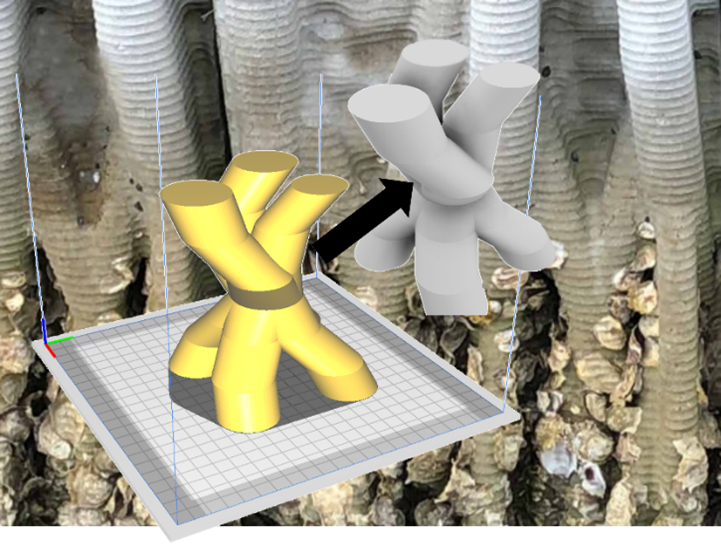
Natural and engineered waterborne infrastructure are critical resources necessary for coastal protection, economic security, and ecosystem services; however, increasing pressures from natural hazard events are compromising the performance and resilience of these systems. Addressing these challenges requires innovative approaches that enhance infrastructure functionality while expanding social, economic, ecological, and recreational benefits. Additive manufacturing (AM), including 3D printing (3DP), presents a promising pathway to transform the design and implementation of nature-inspired infrastructure. These technologies enable the fabrication of complex, bioinspired structures using natural or sediment-based materials, aligning with Engineering With Nature® (EWN®) principles and U.S. Army Corps of Engineers (USACE) infrastructure priorities. Despite this potential, key knowledge gaps remain that limit the transition from conceptual designs to scalable, field-ready applications. To address these gaps, an inaugural collaborative research workshop was convened at the U.S. Army Engineer Research and Development Center (ERDC). The workshop brought together interdisciplinary experts to evaluate current capabilities and define pathways for advancing nature-inspired 3DP solutions. Discussions were organized across four thematic areas: ecosystem restoration and bio-inspired design, coastal resilience, material and sediment properties, and scaling from benchtop to field implementation. Outcomes from the workshop highlight critical research needs, including material standardization, performance validation, and integration with existing engineering practices. This emerging capability also enables the embedding of habitat features, integration of sensors for monitoring infrastructure performance and environmental or security threats, and incorporation of carbon sequestration strategies directly into engineered systems. In addition, AM/3DP supports the retrofitting of existing gray infrastructure, advancing “greening the gray” approaches that enhance resilience and flood protection for both communities and critical assets. Collectively, these findings identify actionable pathways to develop feasible, scalable solutions that deliver multi-benefit outcomes. This work supports a broader paradigm shift toward integrating nature-based approaches with advanced manufacturing technologies in coastal infrastructure.