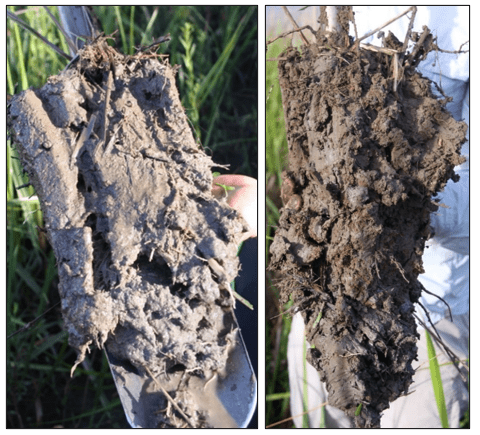
With environmental conditions dynamic by nature, research often aims to understand the factors that influence soil carbon (C) and nitrogen (N) storage through the inhibition of soil organic matter (SOM) mineralization. Characterization of mineral-associated organic matter (MAOM), a stable pool of SOM, has been heavily researched in upland soils, but quantification within wetland soils remains limited. This study sought to quantify MAOM in two distinct natural coastal wetlands in Apalachicola, Florida, one organic and one mineral, and one created coastal wetland and evaluate evidence for SOM stabilization through the perspective of two primarymechanisms: physicochemical protection and biochemical protection. MAOM concentrations were highest in the natural organic wetland (66–108 mg MAOM-C g−1 and 4–15 mg MAOM-N g−1) and lowest in the created wetland (16–33 mg MAOM-C g−1and 1–8 mg MAOM-N g−1). However, within the MAOM pool, the created wetland contained a higher percentage of total C (44%–65%) and N (68%–84%) across the 50-cm soil profile than the natural wetlands, indicating greater efficiency in C and N stabilization. Evidence of SOM stability through physicochemical protection was observed in all wetlands as the percentage of MAOM increased with depth, while indicators of biochemical protection of SOM (i.e., increasing lignin and C:N) were limited. The MAOM pool was better predicted by soil organic properties than by mineral properties. Results from this study demonstrate that MAOM is a major component of coastal wetland soils (comprising 38%–66% of the total C and >60% of the total N) and suggest that MAOM contributes to long-term SOM burial.