Coastal erosion threatens beaches and dunes globally. In the Netherlands, a coastline maintenance policy was implemented in the 1990’s to combat this erosion, with sand nourishments as the primary means. As a result, the Dutch coast is one of the most heavily nourished coasts globally with an average of 12 mln. m3 that is annually added to the coastline of only 432 km for dynamic coastline conservation. Our nourishment approach has evolved over the past 35 years and recently we reported on the lessons learned regarding the nourishment design. Furthermore, we evaluated the cumulative effects of these nourishments against the overarching goals of the coastal policy. Overall, the approach of coastline maintenance with regular proactive nourishments has proven to be successful.
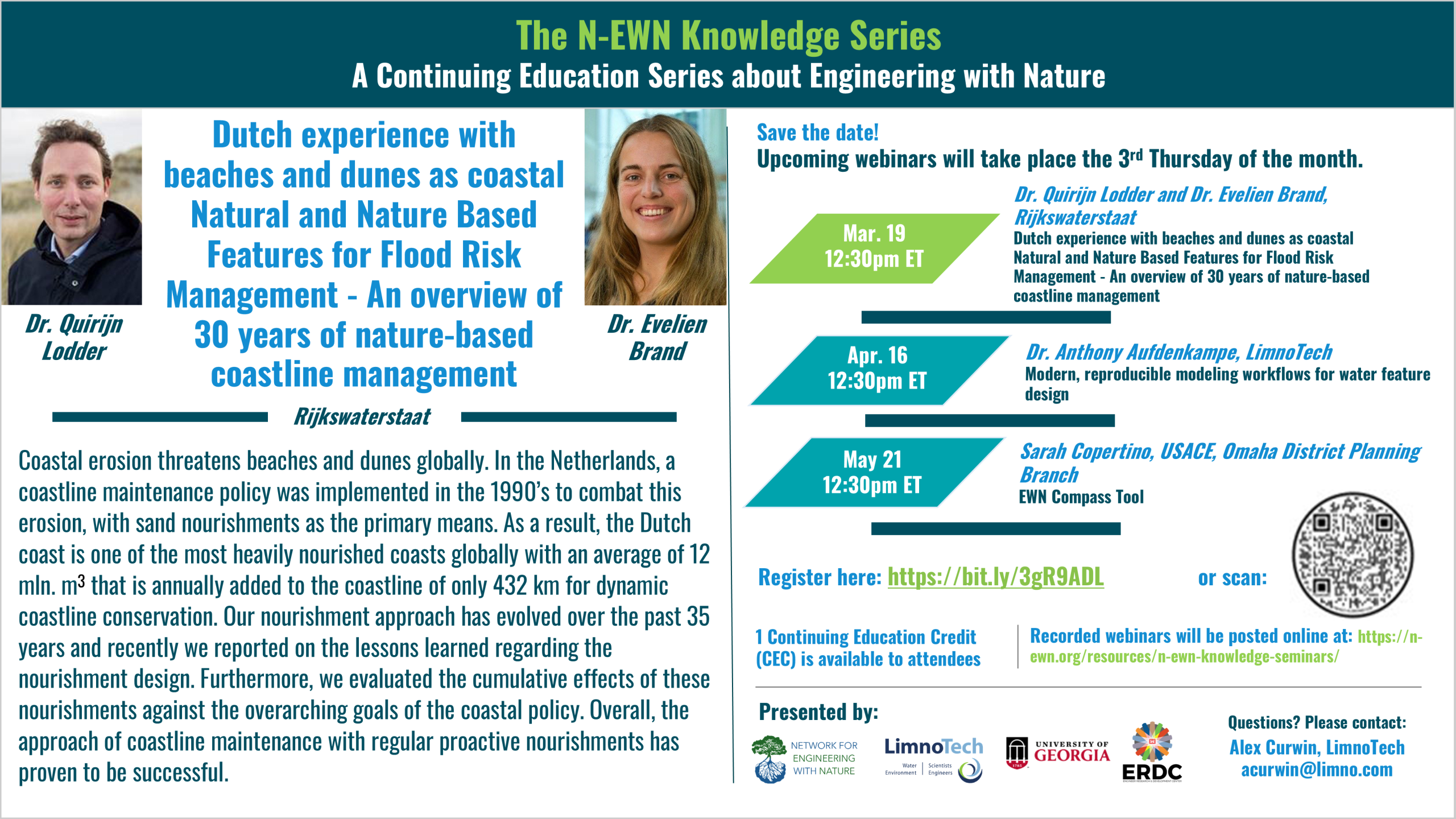
The Network for Engineering With Nature® (N-EWN) invites you to the “N-EWN Knowledge Series: A Continuing Education Series about Engineering with Nature—Dutch experience with beaches and dunes as coastal Natural and Nature Based Features for Flood Risk Management – An overview of 30 years of nature-based coastline management,” presented by Dr. Quirijn Lodder, Principal Advisor Coastal Flood Risk Management, and Dr. Evelien Brand, Technical Lead Coastline Maintenance; both of Rijkswaterstaat. This 1-hour Zoom webinar took place March 19, 2026 at 12:30pm ET.
Related Links
- Brand, E., Lodder, Q., Quataert, E., Slinger, J. (2025). Sustainable coastline management – the cumulative effects of 30 years of nourishments in the Netherlands. ScienceDirect
- Brand, E., Ramaekers, G., & Lodder, Q. (2022). Dutch experience with sand nourishments for dynamic coastline conservation – An operational overview. ScienceDirect
- Bridges, T. S., J. K. King, J. D. Simm, M. W. Beck, G. Collins, Q. Lodder, and R. K. Mohan, eds. (2021). International Guidelines on Natural and Nature Based Features for Flood Risk Management. Vicksburg, MS: U.S. Army Engineer Research and Development Center. http://dx.doi.org/10.21079/11681/41946