Following her graduation from Texas A&M University, Mary A. Bryant joined the Coastal and Hydraulics Laboratory as a research hydraulic engineer. Passionate about the coastal environment, Ms. Bryant applies both numerical and physical model approaches to study nearshore water wave processes. Her EWN-related research explores the roles of vegetation in mitigating coastal flooding, specifically the mechanisms by which vegetation attenuate propagating waves and stabilize coastal dunes.
Related Projects / Publications
Wave Attenuation by Wetland Vegetation
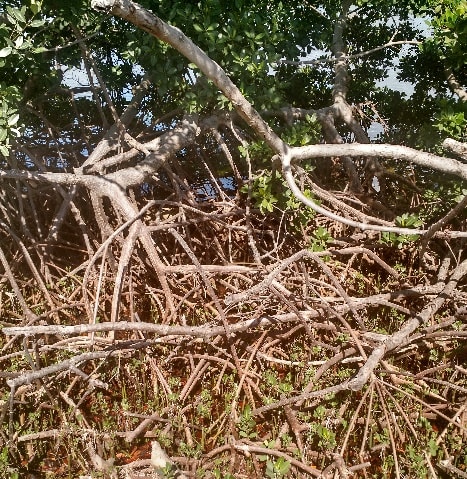
Wave attenuation by coastal vegetation is a dynamic process that plays a critical role in shoreline protection and the modeling of coastal hydrodynamics. To better understand this interaction, researchers conducted large-scale laboratory experiments using polyolefin tubing to represent Spartina alterniflora stands. The study examined key parameters including stem density, vegetation submergence, wave height, and peak period, providing valuable data on how marsh vegetation can reduce wave heights. These findings advance our ability to quantify the protective potential and improve numerical model predictions in coastal ecosystems.
Anderson, M.E. and J.M. Smith. 2014. Wave attenuation by flexible, idealized salt marsh vegetation. Coastal Engineering, Vol. 83: 82-92. https://doi.org/10.1016/j.coastaleng.2013.10.004.
Smith, J. M., M. A. Bryant, and T. V. Wamsley. 2016. Wetland buffers: numerical modeling of wave dissipation by vegetation. Earth Surface Processes and Landforms, Vol. 41, Iss. 6: 847-854. https://doi.org/10.1002/esp.3904.
Smith, J. M., M. E. Anderson, S. K. McKay. 2016. Wave dissipation by vegetation. ERDC-CHL-CHETN-I-82. U. S. Army Corps of Engineers, Engineer Research and Development Center, Coastal and Hydraulics Laboratory. https://hdl.handle.net/11681/1896.
Impact of Vegetation on Dune Erosion
Coastal dunes are a critical first line of defense for many shoreline communities facing tropical and extratropical storms. Although vegetation is thought to enhance dune stability during wave attack, data is limited. This study uses a controlled physical model to assess how both above- and below-ground biomass affect dune resistance using simulated vegetative elements.
Bryant, D. B., M. A. Bryant, J. A. Sharp, G. L. Bell, and C. Moore. 2019. The response of vegetated dunes to wave attack. Coastal Engineering, Vol. 152, 103506. https://doi.org/10.1016/j.coastaleng.2019.103506.
Grzegorzewski, A. S., D. B.Bryant, and M. A. Bryant. 2017. Erosion of coastal foredunes : a review on the effect of dune vegetation. ERDC-CHL CHETN-I-94. U. S. Army Corps of Engineers, Engineer Research and Development Center, Coastal and Hydraulics Laboratory. https://hdl.handle.net/11681/21464.