
Laboratory Study of Wave Attenuation and Spectral Dissipation Induced by Mangroves with Stilt Root Morphology
With rising global temperatures, the poleward migration of mangroves may enhance their contribution to coastal protection. Although the wave attenuation capacity of Rhizophora stilt roots is well established, their influence on wave spectral transformation remains less understood. This study investigates wave height attenuation and associated spectral dissipation using a near-prototype physical model of a Rhizophora […]
Engineering practice guide for oyster reefs : a natural infrastructure approach for coastal systems
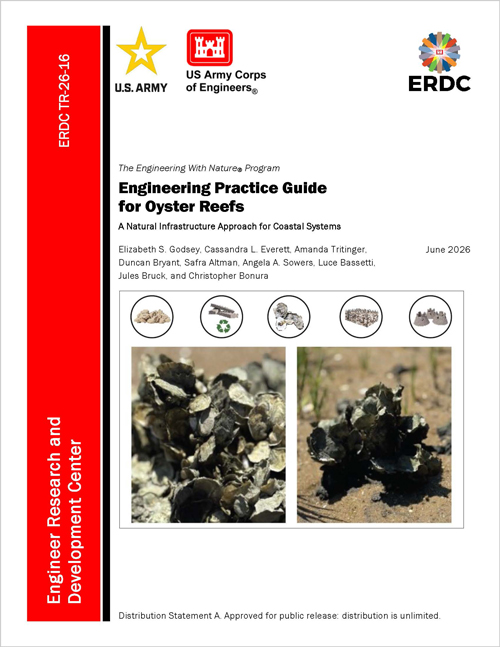
Well-designed oyster reefs enhance coastal resilience by attenuating wave energy, influencing sediment transport, and stabilizing shorelines. As ecosystem engineers, oysters create biogenic reef structures that provide habitat, improve water quality, and support estuarine productivity. When appropriately designed, they can also contribute to coastal storm risk management and navigation improvement objectives. Historically, oyster reefs were widespread […]
Proceedings from the Great Lakes Engineering With Nature® natural and nature-based features playbook workshop
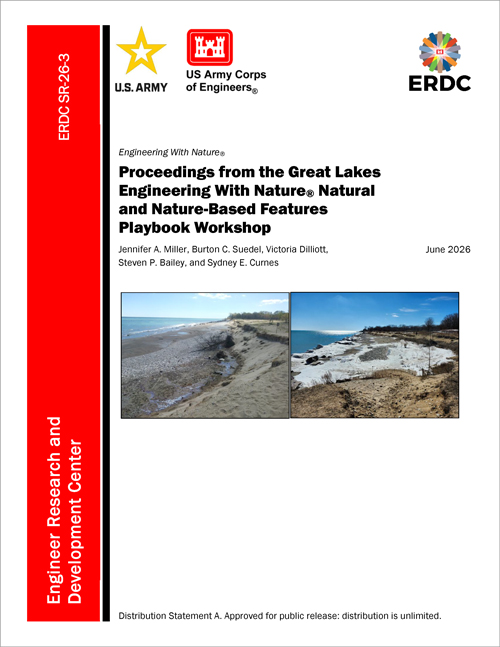
Communities in the Great Lakes are experiencing increased frequency in coastal flooding and erosion, causing property damage, putting lives at risk, and disrupting local economies. To address these challenges, two workshops were conducted (18 February 2025 [virtual] and 26–27 February 2025 [in person]) to collect knowledge, insights, and feedback from community members, policymakers, and Tribal […]
Can fine sediment addition promote carbon stabilization in coastal wetland soils? A laboratory experiment

Scientists are increasingly exploring soil carbon (C) stabilization processes that protect soil organic C from microbial decomposition. Mineral-associated organic matter (MAOM) is considered one of the most protected pools of soil C, but remains understudied in wetland soils relative to upland soils. Using complementary intact soil core and bottle incubation studies, this research investigated how […]
Field Evidence of Carbon and Nitrogen Stabilization Through Mineral-Associated Organic Matter Formation in Coastal Wetland Soils
With environmental conditions dynamic by nature, research often aims to understand the factors that influence soil carbon (C) and nitrogen (N) storage through the inhibition of soil organic matter (SOM) mineralization. Characterization of mineral-associated organic matter (MAOM), a stable pool of SOM, has been heavily researched in upland soils, but quantification within wetland soils remains […]
Engineering With Nature® Proving Grounds Innovation Handbook
The Engineering With Nature® Proving Grounds Innovation Handbook provides a comprehensive framework for integrating innovative natural and nature-based features and sediment management strategies to address climate-driven hazards and increase resilience in coastal and fluvial environments. Developed through collaboration between engineers, scientist, landscape architects, and U.S. Army Corps of Engineers districts and divisions, the EWN Handbook […]
Coastal nature-based solutions and remote sensing data: selecting performance metrics and evaluating data availability
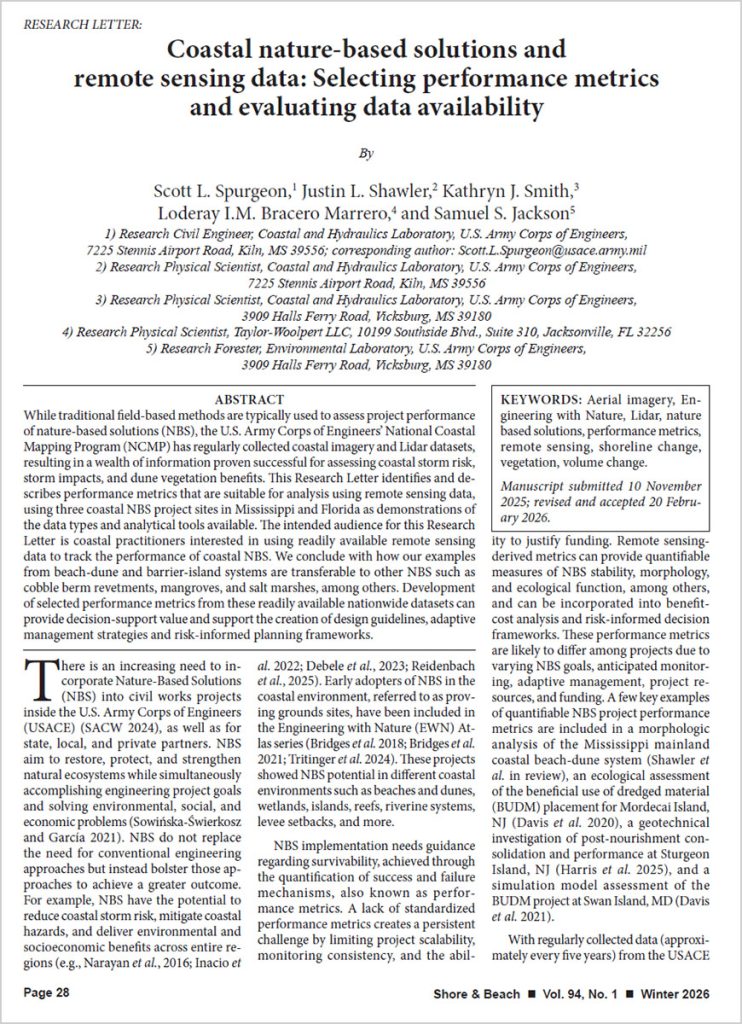
While traditional field-based methods are typically used to assess project performance of nature-based solutions (NBS), the U.S. Army Corps of Engineers’ National Coastal Mapping Program (NCMP) has regularly collected coastal imagery and Lidar datasets, resulting in a wealth of information proven successful for assessing coastal storm risk, storm impacts, and dune vegetation benefits. This Research […]
Building Tomorrow: Unlocking the Potential of Additive Manufacturing to Revolutionize Coastal Infrastructure
Natural and engineered waterborne infrastructure are critical resources necessary for coastal protection, economic security, and ecosystem services; however, increasing pressures from natural hazard events are compromising the performance and resilience of these systems. Addressing these challenges requires innovative approaches that enhance infrastructure functionality while expanding social, economic, ecological, and recreational benefits. Additive manufacturing (AM), including […]
Upscaling nature-based solutions for reducing risk from natural hazards: From process to practice
Nature-based solutions (NbS) offer an innovative approach to reducing risks from natural hazards, aligning ecological processes with engineering objectives. However, successfully scaling NbS from site-specific interventions to systems-level applications remains a challenge. This paper examines an Engineering With Nature® (EWN®) case study to explore how NbS can be integrated into broader, systems-based engineering practices, demonstrating […]
Developing an inventory of US Army Corps of Engineers’ nature-based infrastructure projects
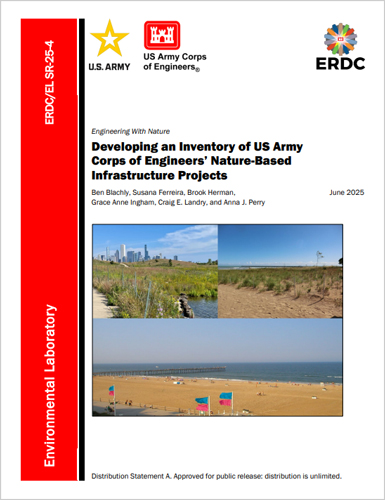
The purpose of this report is to recommend a framework for developing a comprehensive database of US Army Corps of Engineers’ (USACE) natural infrastructure (NI) projects. Natural infrastructure is defined as an area or system that is naturally occurring, naturalized, or constructed to mimic naturally occurring features and then intentionally managed to enhance ecosystem value […]